
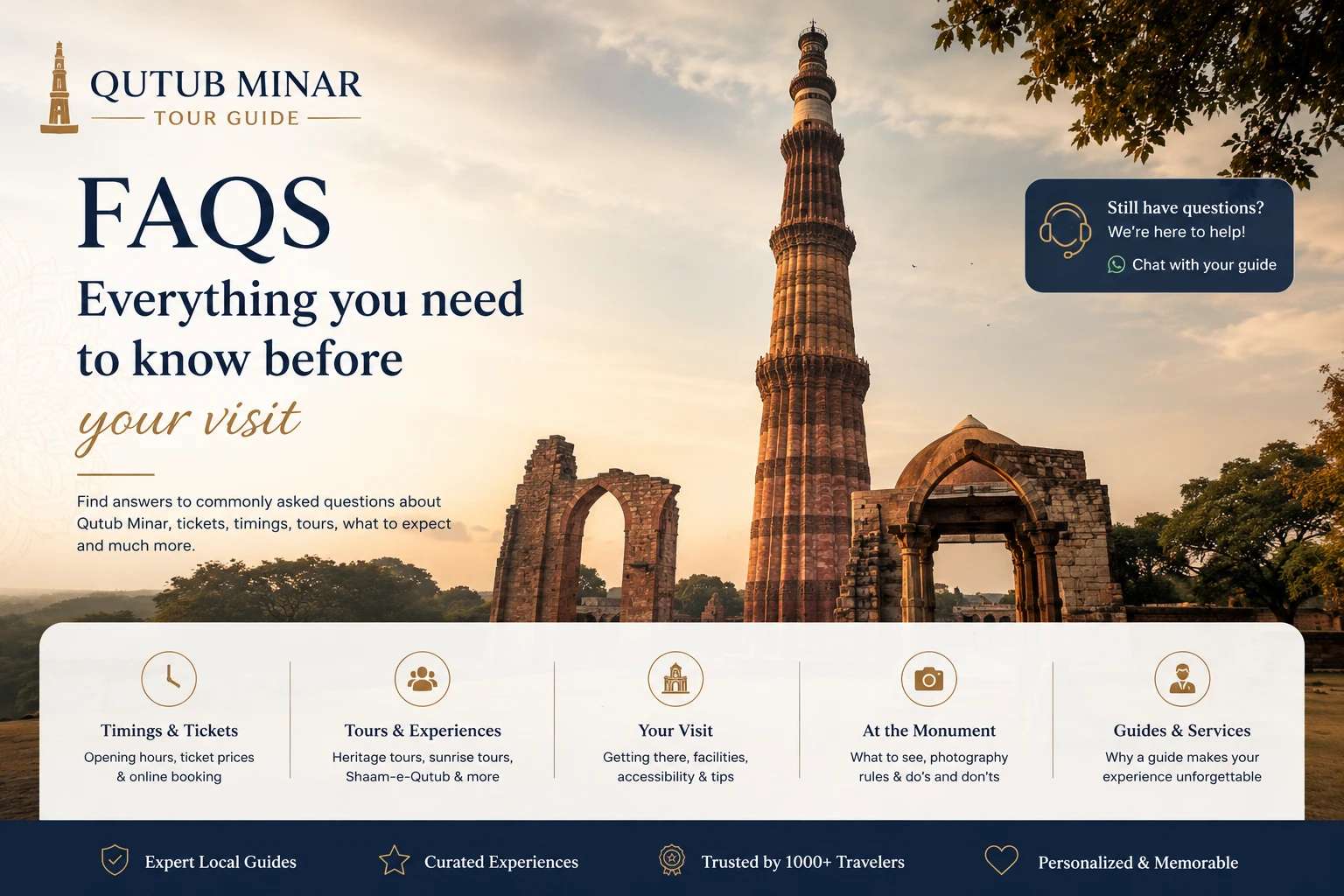
Qutub Minar Tour FAQ — 17 Essential Questions Answered
Planning Your Qutub Minar Tour FAQ — Timings, Tickets & Guide Services
This Qutub Minar Tour FAQ is your complete pre-visit guide. This Qutub Minar Tour FAQ covers timings, tickets, photography, accessibility, transport, and guided tour options — all answered by Pravin Pandey, your licensed Qutub Minar Tour guide. Bookmark this Qutub Minar Tour FAQ and refer back before your visit.
Whether you are a first-time visitor or returning traveller, this Qutub Minar Tour FAQ will help you get the most from your Qutub Minar Tour experience.
What are the opening and closing times of Qutub Minar?
Qutub Minar is open all seven days of the week, generally from Sunrise to 9:00 PM
What is the entry fee for Qutub Minar?
The current admission fee is ₹40 per person for Indian ( Online ₹ 35 ), For foreign visitors, the fee is ₹600 ( Online ₹ 550 ) Children below 15 years of age are admitted free.
Can I book Qutub Minar tickets online?
Yes. Qutub Minar tickets can be booked online through the ASI ticketing portal. https://asi.payumoney.com/
Is photography allowed?
Yes, personal photography is allowed throughout. Tripods and professional/commercial shoot equipment require prior permission from the ASI.
Is climbing to the top of Qutub Minar allowed?
No — the interior has been closed to visitors since 1981 for safety and preservation reasons. You can admire it up close from ground level and explore the surrounding complex, including the Iron Pillar, Alai Darwaza, and the tombs of Iltutmish and Alauddin Khalji.
What is the nearest metro station?
Qutab Minar or Saket Metro station on the Yellow Line — about 10–15 minutes by auto-rickshaw or cab from the complex and the Mehrauli Archaeological Park.
Is there parking available near Qutub Minar?
Yes, paid parking is available near the entrance. I can share the exact drop-off point when confirming your booking.
What are the opening and closing hours of Mehrauli Archaeological Park?
The park is open daily, roughly from sunrise to sunset . Since it’s a large, open heritage park rather than a single ticketed monument, timings are more flexible than Qutub Minar’s — early morning is the best time to explore it comfortably.
Is there an entry fee for Mehrauli Archiological Park ?
The park itself is generally free to enter, though a nominal fee apply for specific protected structures inside (like Jamali Kamali Tomb). I’ll confirm the latest applicable rates before your visit.
What are the opening and closing hours of Mehrauli Archaeological Park?
The park is open daily, roughly from sunrise to sunset . Since it’s a large, open heritage park rather than a single ticketed monument, timings are more flexible than Qutub Minar’s — early morning is the best time to explore it comfortably.
How much time should I set aside to visit Qutub Minar and the surrounding complex?
About 1– 1.5 hours for Qutub Minar itself, and 2–3 hours if you’d also like to explore the Mehrauli Archaeological Park. Most of my guided tours are designed around this combined experience.
Can you arrange group or school/corporate tours?
Yes — I regularly guide school groups, corporate teams, and larger delegations. Group sizes, pricing, and itineraries can be customized; reach out via the Book Now page with your group size and preferred date.
Is Qutub Minar wheelchair accessible?
Yes, the Qutub Minar complex has accessibility facilities including ramps, accessible pathways and wheelchairs for visitors who need them. However, some areas have uneven surfaces and heritage features that can still be challenging for wheelchair users. The interior of Qutub Minar itself is not open to visitors. If you have mobility requirements, I can help plan a comfortable route focusing on the most accessible parts of the complex.
Do you offer tours in languages other than English?
Yes — I conduct tours in both Hindi and English. And other linguistic guide like French, Spanish , German, Italian & Russian, will also be available on prior booking.
Do I need a guide, or can I visit Qutub Minar independently?
You can certainly visit Qutub Minar independently, but a knowledgeable heritage guide can help you understand the stories, architecture, inscriptions, rulers, and historical connections that are easy to miss on your own. My private tours are designed for travellers who want to go beyond photographs and understand the monument in its wider historical context. If you simply want to see the monument, independent visiting is possible; if you want to understand its history and hidden details, a guided experience can make the visit much more meaningful.
What is the best time of day to visit Qutub Minar?
Early morning is the best time to visit Qutub Minar if you want calm, cooler weather and soft, photogenic light. Late afternoon (especially the golden hour) is also beautiful — the warm tones bring out the stone textures and the site takes on a relaxed evening atmosphere. The right time for you depends on what you want to experience; below are my tour options so you can pick the one that matches your interests.
Sunrise View of Qutub Minar — Perfect for photographers, early-risers, and anyone who wants a peaceful start to the day with dramatic morning light and fewer visitors.
Qutub Minar Heritage Tour — A daytime guided walk focused on history, archaeology, and storytelling; ideal for visitors who prefer a full interpretive tour during regular hours.
Shaam-e-Qutub — Best for late-afternoon and golden-hour visits; enjoy atmospheric lighting, cooler temperatures, and an evening mood that’s great for relaxed strolls and photography.
Qutub Ki Paathshala — A hands-on, interactive session (suitable for students, curious travelers, and families) that can be scheduled at times that suit your group; we can recommend morning or afternoon slots depending on the season and learning goals.
If you tell me your preferred dates, interests (photography, archaeology, family-friendly, or a relaxed stroll), and group size, I’ll recommend the best tour and time and provide the direct booking link. Which experience would you like to highlight on your booking page?
What should I wear and bring for a Qutub Minar visit?
Wear comfortable walking shoes and light, breathable clothing, especially during the warmer months. We recommend carrying a bottle of water, sunscreen, sunglasses, and a hat or scarf. During winter, mornings and evenings can be cool, so a light jacket or additional layer is useful. A camera or smartphone is also recommended—the Qutub Minar complex offers excellent photography opportunities.
How do I avoid fake or unauthorized guides?
Before booking a guide, always ask to see their valid government-issued guide ID/badge. For ASI-protected heritage monuments such as Qutub Minar, look for an Incredible India Tourist Guide (IITG) with appropriate credentials. IITGs receive formal training and certification under the Ministry of Tourism framework.
If someone cannot show valid credentials, be cautious and verify before booking.
Who can guide me at Qutub Minar? How do I avoid unauthorized or fake guides?
At Qutub Minar, visitors are usually approached by three different types of people offering guide services. Knowing the difference helps you choose wisely and get real value from your visit.
1. IITG: Incredible India Tourist Guide (Heritage Specialist)
Authorized by the Ministry of Tourism, Government of India, and recognized by the ASI to guide at protected monuments.
Trained and tested in history, architecture, and heritage interpretation.
Carries an official photo ID card.
Gives you accurate, in-depth, quality storytelling and a better visit.
2. IITF: Incredible India Tourist Facilitator
Not authorized by the ASI or the Government of India to provide guiding services at ASI monuments.
The minimum qualification is 10th class, so they have only basic knowledge of heritage and monuments.
Do not expect deep or expert-level guiding.
3. Unofficial or Fake Guides (Touts, Self-Declared Guides, Part-Timers)
Includes people with no valid guide license, people wearing look-alike ID cards, and some guards or gardeners who do part-time guiding for extra income.
They have no formal training or accountability, and their stories are often inaccurate or made up.
They may charge unfair prices or pressure you into a deal at the gate.
How to choose safely
Ask to see the Ministry of Tourism IITG ID card before you agree to anything.
Fix the price and duration in advance.
Better still, pre-book a licensed guide so you are not negotiating at the entrance.
If someone approaches you aggressively, politely decline and walk on.
The choice is yours, but a licensed IITG guide is the only option that is officially authorized and trained to guide you at Qutub Minar.
Want a verified, licensed guide? [Chat with Pravin Pandey, Government of India Licensed Guide →]
Ready to visit ? Book your Qutub Minar Heritage Tour today, or explore our Mehrauli Heritage Walk and Shaam-e-Qutub evening experience.
For official timings and ticket prices, visit the Archaeological Survey of India website.
Still have questions about your Qutub Minar Tour FAQ?
This Qutub Minar Tour FAQ is updated regularly. For personalised advice about your Qutub Minar Tour, contact Pravin directly via WhatsApp — your expert Qutub Minar Tour guide in Delhi.